


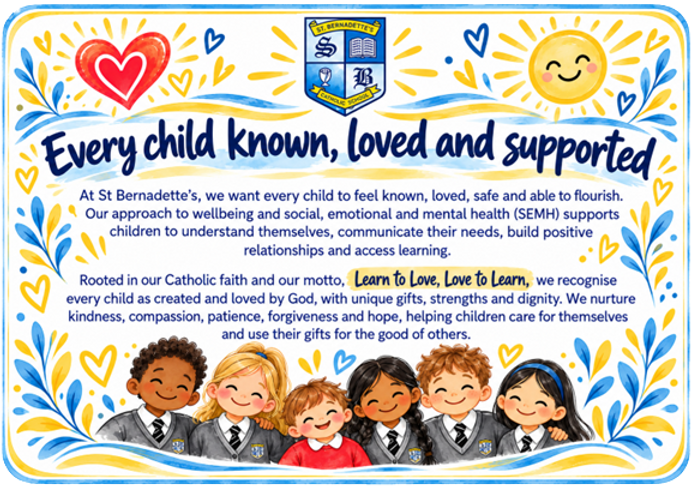

Our whole-school wellbeing programme, Happy Hearts, Brilliant Brains, runs from Nursery to Year 6. It gives children a shared language for emotions, body signals, relationships, learning and asking for help. Children take part in short 5–10 minute lessons, with the ideas revisited throughout everyday school life. Learning develops as children move through school.
What will children learn?
Across the year, children explore six connected units:

Understanding feelings and learning to regulate
All feelings give us information. Children learn that feelings themselves are not good or bad: they can help us notice what is happening and what we might need. We support children to understand their feelings and respond in ways that keep themselves and others safe.
Children do not have to become calm before they deserve help. Adults offer reassurance and co-regulation — helping children manage feelings through a supportive relationship — and help them notice body clues, communicate their needs and explore suitable strategies. Self-regulation is taught, modelled and practised.
Support might include movement, comfortable breathing, a quieter space, visual prompts, sensory activities or time with a trusted adult. Where appropriate, sensory circuits provide a structured sequence of movement activities to support children’s regulation and readiness for learning. Activities are adapted to individual needs, with adults noticing how children respond and what helps them.
From Nursery onwards, we introduce and revisit a range of self-regulation strategies. Explore some of the strategies we use in school below.


Support matched to each child
All children benefit from our whole-school approach. Some need additional support at particular times or more sustained help with their social, emotional and mental health needs. We work with children, families and relevant professionals to understand those needs and agree appropriate support.
Our class teachers, pastoral team and SENCo work together to identify barriers and adapt support. This may include individual check-ins, help with friendships, adjustments to routines or learning environments, and targeted pastoral support. Where appropriate, we work with specialist services.
We recognise that children communicate feelings and needs in different ways. Adults use accessible language, visuals, modelling, repetition and different ways to communicate so that every child can participate and feel heard.
We review support with children and families, looking at how it helps communication, relationships, participation and access to learning. Happy Hearts, Brilliant Brains complements our pastoral, SEND and safeguarding provision; it does not replace specialist support or therapy.
Safe, trusted adults and asking for help
Children never have to manage difficult feelings alone. We help them identify safe, trusted adults and remind them that if something feels unsafe, worrying or uncomfortable, they should tell a trusted adult and keep telling until somebody helps.
Children can speak to their class teacher or another safe, trusted adult in school. Families can find our safeguarding contacts and reporting information on our Safeguarding page
Working together with families
If you are worried about your child’s wellbeing, please speak to their class teacher. We can work together to understand your concerns and, where appropriate, involve our pastoral team or SENCo. Please contact the school office on 0121 783 7232 if you need help arranging a conversation.
At home, you can help by listening without rushing to solve a feeling, naming emotions together, noticing what helps your child and reminding them that asking for support is a strength. A helpful starting point is: What are you noticing, and what might help?
We value families’ knowledge of their children and welcome information about changes or worries that may affect them. Together, we can help children feel secure, connected and ready to learn.
